Featured Project
Chu Chu: An Interactive Companion Robot
Awarded 2nd place among our class of ME322 engineering design projects for its integration of mechanical design, embedded electronics, and behavioral software Named after the Japanese onomatopoeia for a mouse squeak 「ちゅうちゅう」("chu chu"), reflecting the robot's playful, mouse-inspired design
Overview
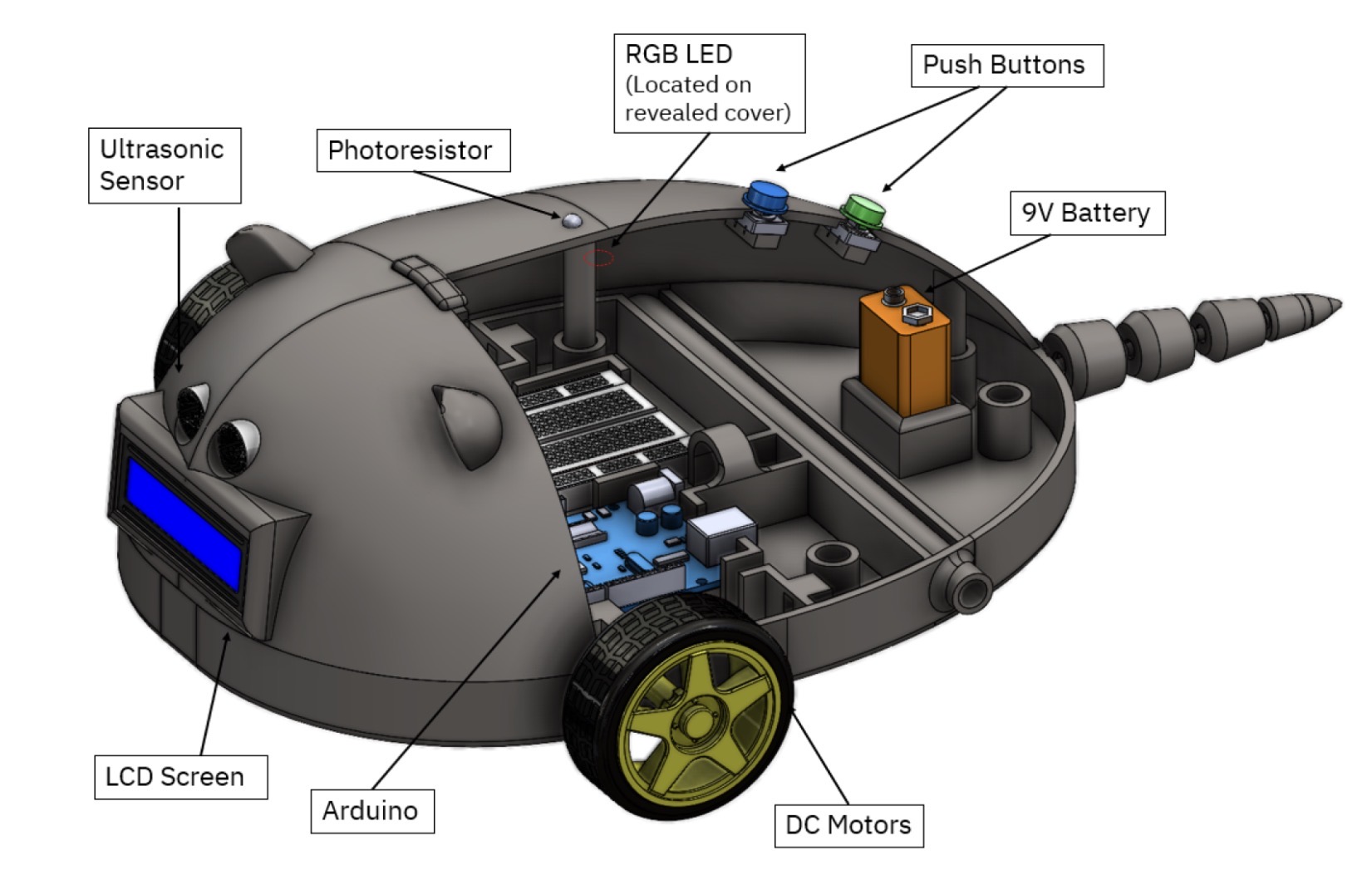
Chu Chu is a mobile robotic companion designed to simulate the behavior of a living pet through autonomous movement, expressive behaviors, and responsive user interaction. The project integrated custom mechanical design, embedded electronics, electrical system architecture, and behavioral software into a compact electromechanical platform capable of responding to both its environment and its owner. Users interact with Chu Chu through simulated feeding, petting, and attention, while a dynamic personality system combines randomized state generation, timed emotional transitions, and sensor-driven user interactions to continuously adapt movement, facial expressions, RGB lighting, and unlockable behaviors, creating a more engaging and lifelike companion.
Key Results
2nd Place
Awarded second place among our class of ME322 design projects
4 Main Parts + Tail
PLA body assembly with modular electronics access
Happy, Playful, Lonely, & Hungry
Dynamic emotional states simulated through software and hardware outputs
7.19 hr
Estimated battery life determined through power consumption analysis
My Contributions
- Served as electromechanical lead, leading the mechanical design while co-developing the electrical architecture and system integration.
- Designed the complete robot assembly in SOLIDWORKS, including the chassis, drivetrain, structural components, integrated mounting features, and exterior body panels.
- Defined subsystem packaging and electrical component placement, developing the wiring architecture and integrating five sensing, actuation, and feedback subsystems into a compact electromechanical platform.
- Performed structural, torque, and power analyses to validate the design prior to fabrication, then contributed to prototype assembly, system testing, and iterative refinement.
Mechanical Design
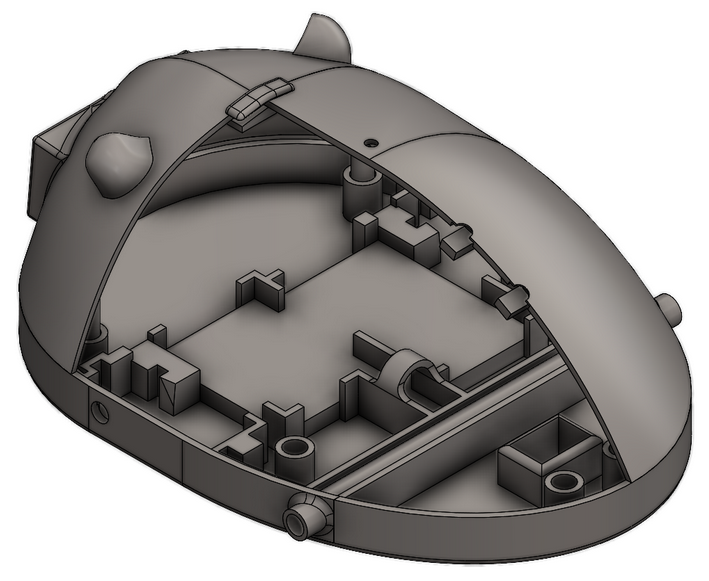
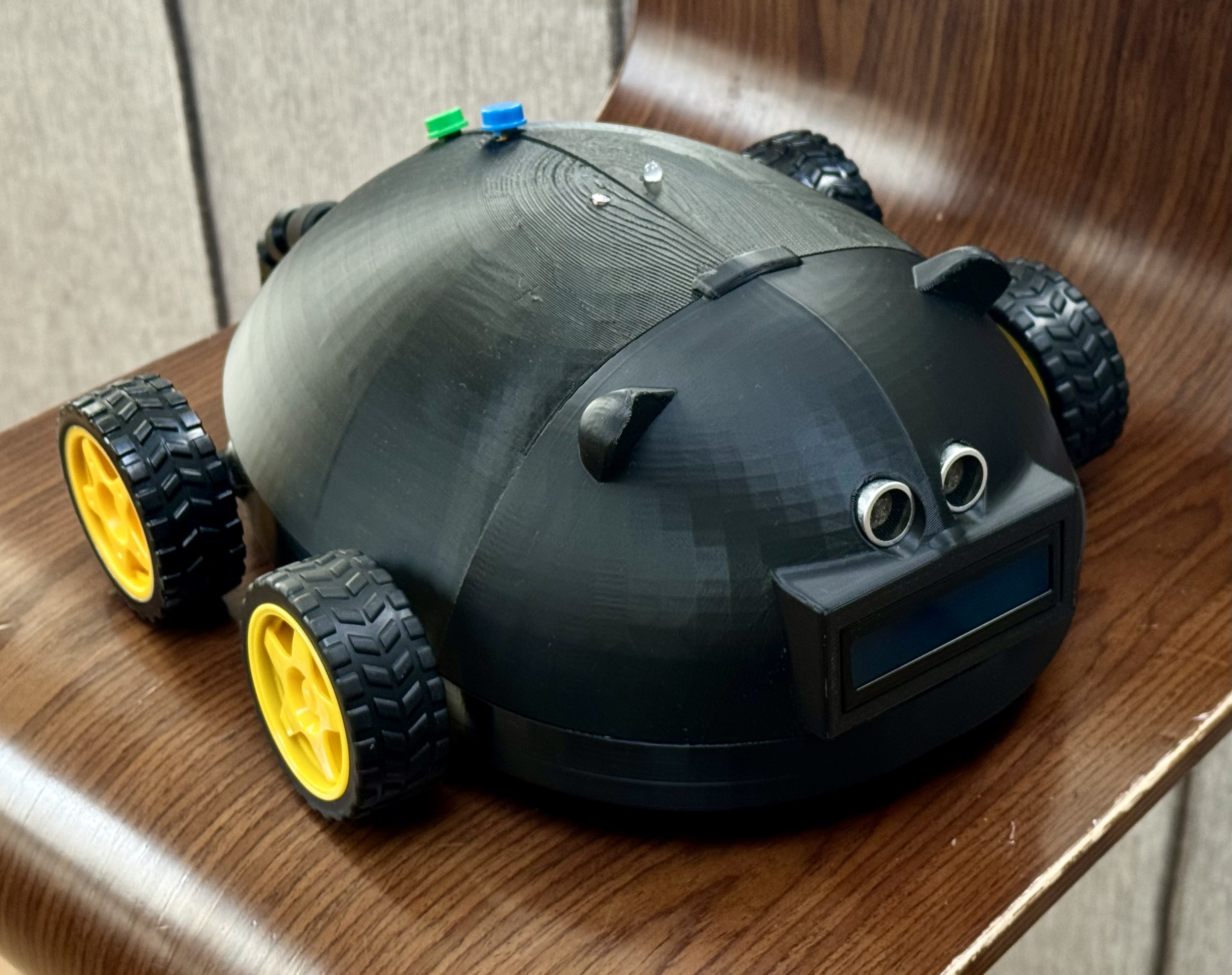
Chu Chu was designed in SOLIDWORKS as a compact electromechanical platform that integrated the drivetrain, sensors, battery, microcontroller, and display within a fully 3D-printed PLA body. The final assembly consisted of five printed components that balanced structural rigidity, manufacturability, and serviceability while maintaining a friendly mouse-inspired appearance.
The chassis incorporated integrated mounting features for every major subsystem, eliminating the need for secondary brackets while improving packaging efficiency and simplifying assembly. Through multiple design iterations, the mechanical architecture was refined to improve component packaging, wire routing, structural durability, and drivetrain performance before final fabrication.
Electronics and System Architecture
- Arduino microcontroller for autonomous behavior and emotional state control
- Ultrasonic sensor for obstacle detection and autonomous movement
- LCD display for facial expressions and emotional feedback
- PCF8574 I2C LCD interface module for reduced two-wire LCD communication
- RGB LED for additional emotional state indication
- Push buttons and photoresistor for interactive user input
- DC motors and drivetrain system for autonomous roaming behavior
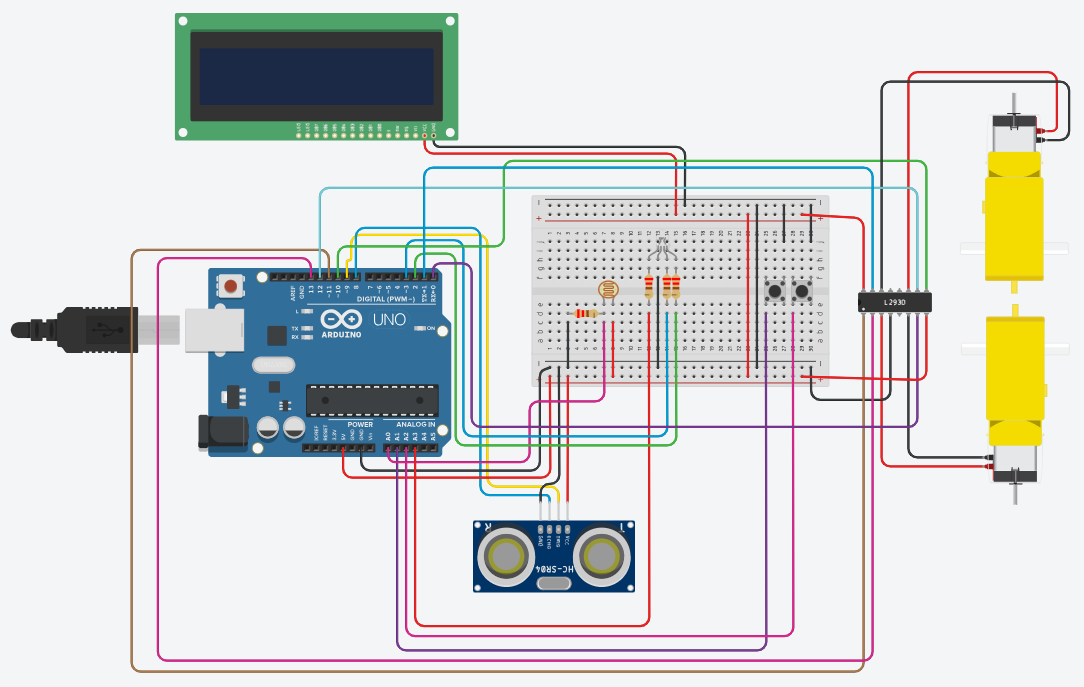
The electronics architecture prioritized compact packaging, efficient I/O utilization, and reliable integration within the limited chassis volume. The system was first developed and validated in Tinkercad before physical implementation, allowing the circuitry and software to be tested prior to assembly. To overcome the Arduino Uno's limited GPIO resources, a PCF8574-based I2C interface module reduced the LCD connection from six pins to two, freeing additional I/O for the ultrasonic sensor, RGB LED, push buttons, and other system functions while simplifying the overall wiring architecture.
Autonomous Behavior Logic
Chu Chu simulated an evolving personality through emotional state logic, environmental sensing, and user interaction. Push buttons and a photoresistor represented feeding, petting, and attention, allowing users to directly influence the robot's emotional state and behavior.
Emotional conditions controlled movement patterns, LCD facial expressions, and RGB LED outputs. A dynamic happiness system rewarded positive interaction by unlocking additional behaviors and tricks, while lower emotional states produced more passive responses. Ultrasonic sensing enabled autonomous roaming and obstacle avoidance throughout operation.