Featured Project
NaviBot: Autonomous Navigator
Designed and rapidly prototyped a fully autonomous navigation robot through six major iterations, integrating ultrasonic obstacle avoidance, LiDAR-based position tracking, and coordinate-based pathfinding to complete the final course in 1 minute 21 seconds with zero collisions.
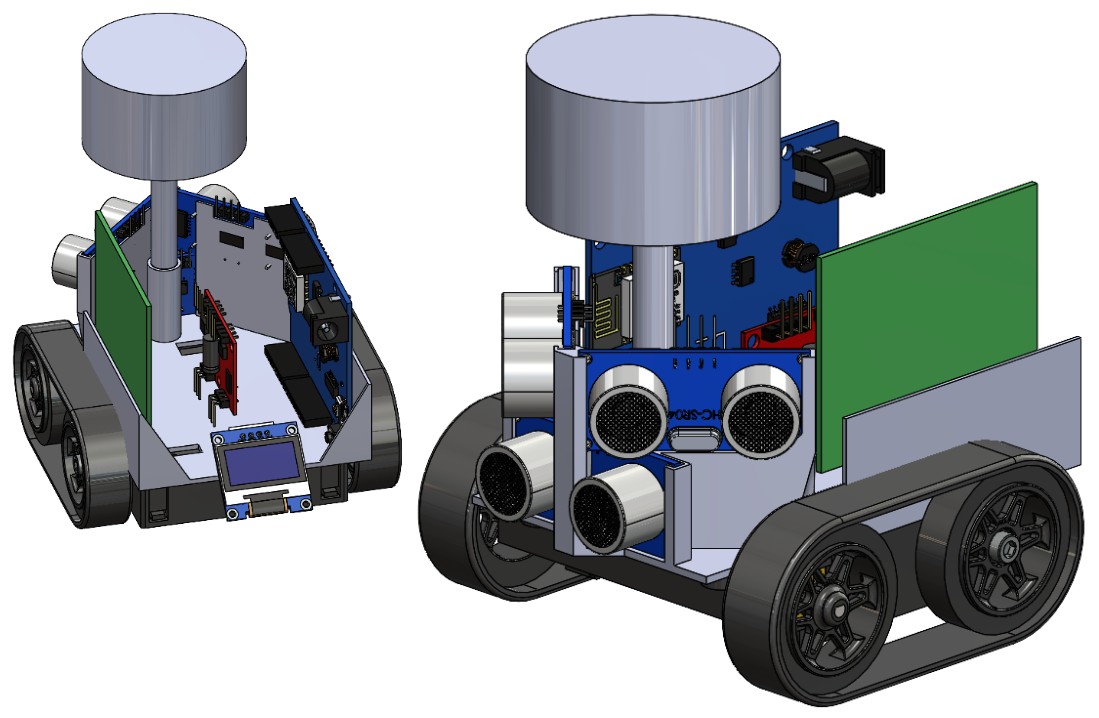
Overview
NaviBot is a fully autonomous robot developed through a 5-week rapid-prototyping process to navigate a smart obstacle course without human control. The system combined ultrasonic obstacle detection, MQTT-delivered LiDAR position data, coordinate-based pathfinding, and a custom 3D-printed chassis into a compact mobile platform.
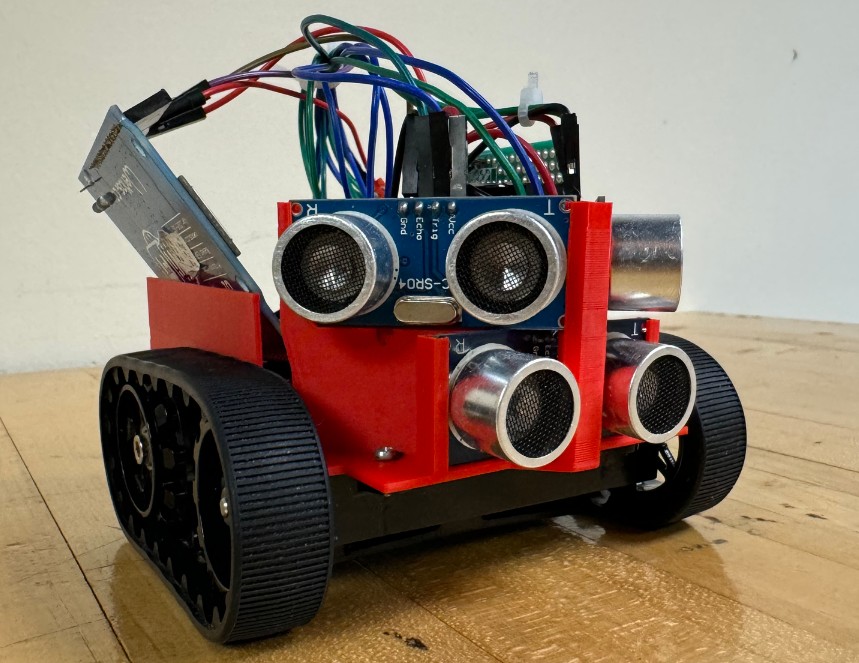
Six major chassis iterations were designed, fabricated, assembled, and tested as the project progressed through increasingly complex navigation challenges. Each prototype addressed problems discovered during physical testing, including sensor alignment, drivetrain stability, wire interference, electronics packaging, and component retention. The final robot reached four assigned target locations in 1 minute 21 seconds while completing the course with zero collisions.
Key Results
1:21
Final autonomous course completion time
Zero Collisions
Complete navigation without error
6 Iterations
Prototypes designed, assembled, and tested
Real-time Position Tracking
Autonomous navigation utilizing MQTT & LiDAR
My Contributions
- Led the mechanical design and rapid prototyping of six major chassis iterations in SOLIDWORKS.
- Designed integrated mounting features for the drivetrain, three ultrasonic sensors, OLED display, LiDAR tracking float, microcontroller, motor driver, and power distribution board.
- Evaluated each prototype through dimensional inspection, assembly, and physical road testing, then revised the design to improve sensor retention, drivetrain stability, wire routing, component packaging, and manufacturability.
- Contributed to system assembly, autonomous-navigation testing, and iterative tuning of the pathfinding and obstacle-avoidance system.
Mechanical Design
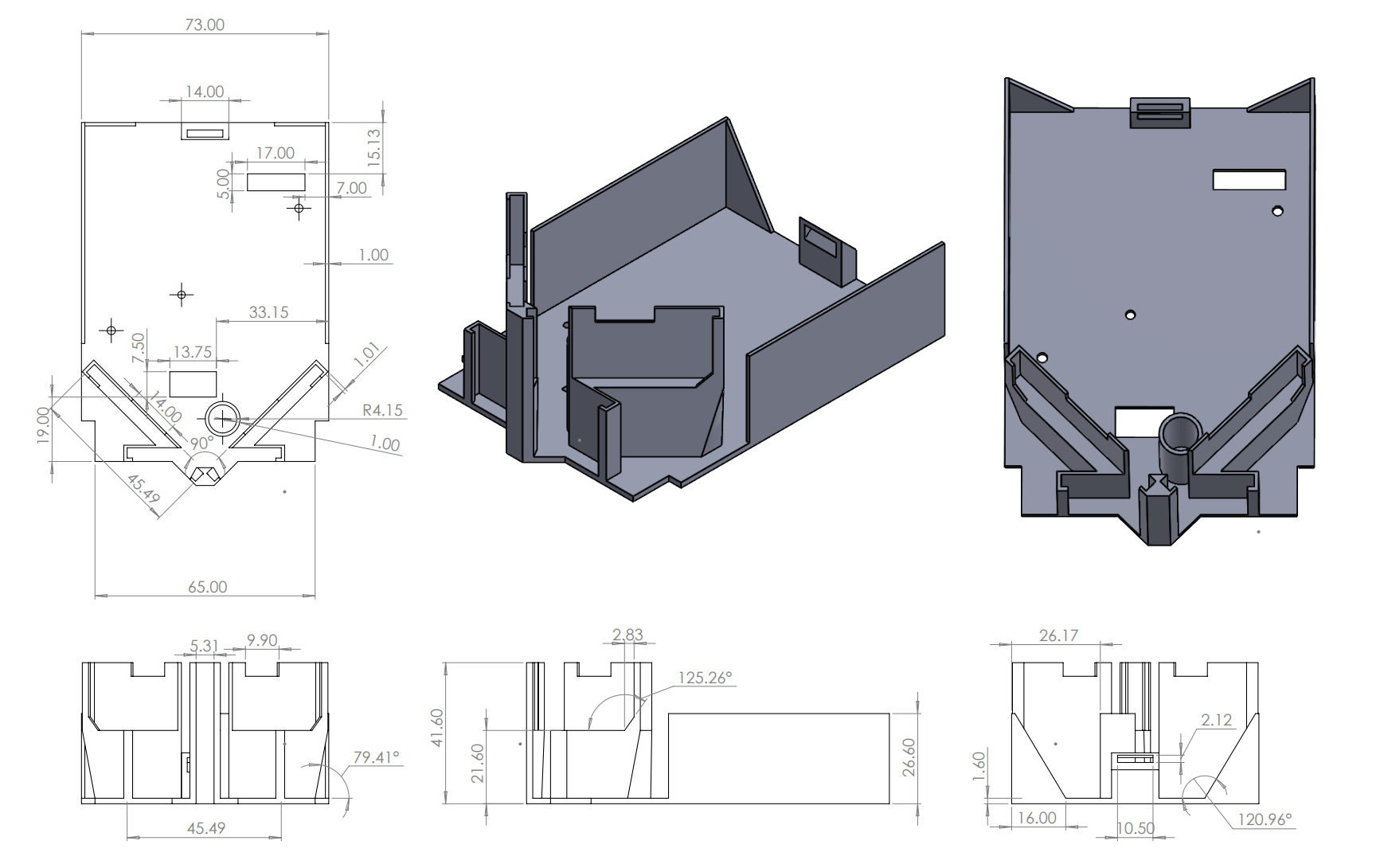
NaviBot was designed in SOLIDWORKS as a compact, single-piece chassis mounted above a Pololu Zumo drivetrain. Integrated features supported the ultrasonic sensors, OLED display, LiDAR tracking float, motor driver, WeMos microcontroller, and power distribution board while keeping the complete chassis within the four-hour printing limit.
The mechanical architecture was developed through repeated build-test-redesign cycles. Physical testing revealed issues that were not apparent in CAD, including loose sensor mounts, drivetrain movement, wires interfering with the tracks, uneven weight distribution, and insufficient electronics space. Each successive prototype incorporated targeted changes before being fabricated and evaluated in the next road test.
Rapid Prototyping and Design Iteration
Six chassis models were produced throughout four major stages. Each model printed as a single part, assembled with the robot hardware, and evaluated through physical testing before the next revision was developed.
Initial Platform
Began with an experimental base plate used to establish the drivetrain interface, chassis dimensions, bolt locations, and first ultrasonic sensor mount.
First Road-Test Chassis
Corrected the sensor fit and raised the WeMos mounting position to create space for the motor controller, producing the first fully integrated road-test prototype.
Three-Sensor Integration
Added two 45-degree ultrasonic sensor mounts, expanded the electronics area, stabilized the motors, separated wiring from the tracks, and incorporated the LiDAR tracking-float mount.
Final Chassis
Replaced the peg-based board mounts with a compact crate-style compartment, tightened the sensor interfaces, and added an angled OLED mount to improve packaging, accessibility, wire management, and reliability.
Electronics and System Architecture
- Wemos D1R1 (ESP8266) microcontroller for autonomous navigation control
- Three ultrasonic sensors for real-time obstacle detection and wall tracking
- DC drivetrain motors with motor driver integration for autonomous movement
- OLED display for live coordinate and navigation feedback
- Perfboard for organized power and signal distribution
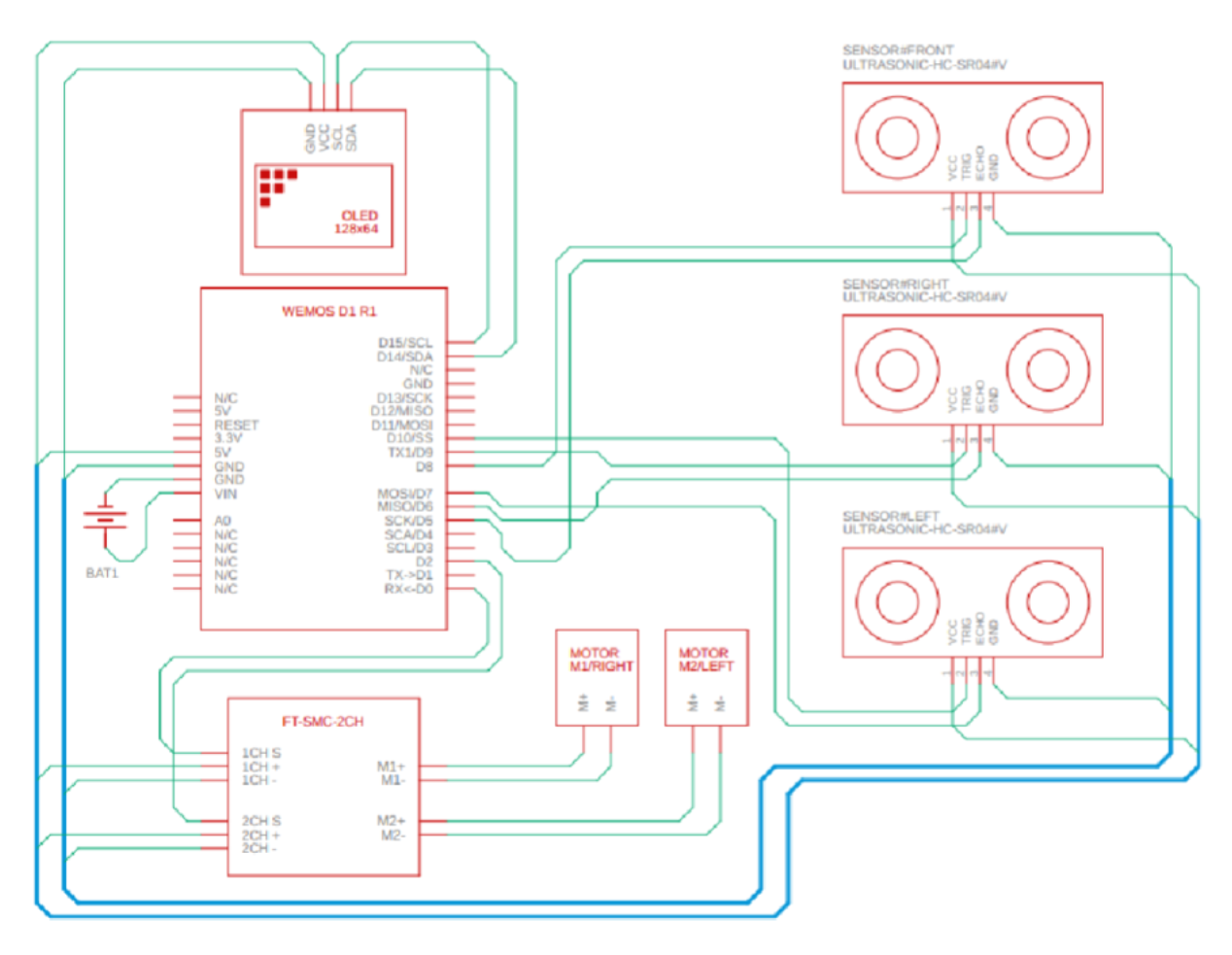
The electronics architecture integrated the WeMos D1R1 microcontroller, motor driver, three ultrasonic sensors, OLED display, drivetrain motors, and a soldered power-distribution board within the compact chassis. Development initially relied on temporary wiring before transitioning to a soldered board for the final assembly, providing additional power and ground connections while improving organization and reliability. Color-coded wiring and zip ties were used to simplify troubleshooting and prevent cables from interfering with the drivetrain.
Autonomous Navigation Logic
NaviBot combined coordinate-based pathfinding with real-time obstacle avoidance to navigate the competition arena without human input. Position data provided through the MQTT network and LiDAR tracking system allowed the robot to continuously determine its location, calculate its orientation relative to target coordinates, and adjust its movement toward each destination.
Three ultrasonic sensors provided obstacle detection and wall-tracking capabilities, allowing the robot to identify nearby obstacles and make directional corrections during navigation. A major software challenge was balancing target-seeking behavior with collision avoidance, requiring iterative tuning of sensor thresholds, motor outputs, and decision logic. The final navigation algorithm successfully guided the robot through the course with zero collisions and a completion time of 1 minute 21 seconds.